
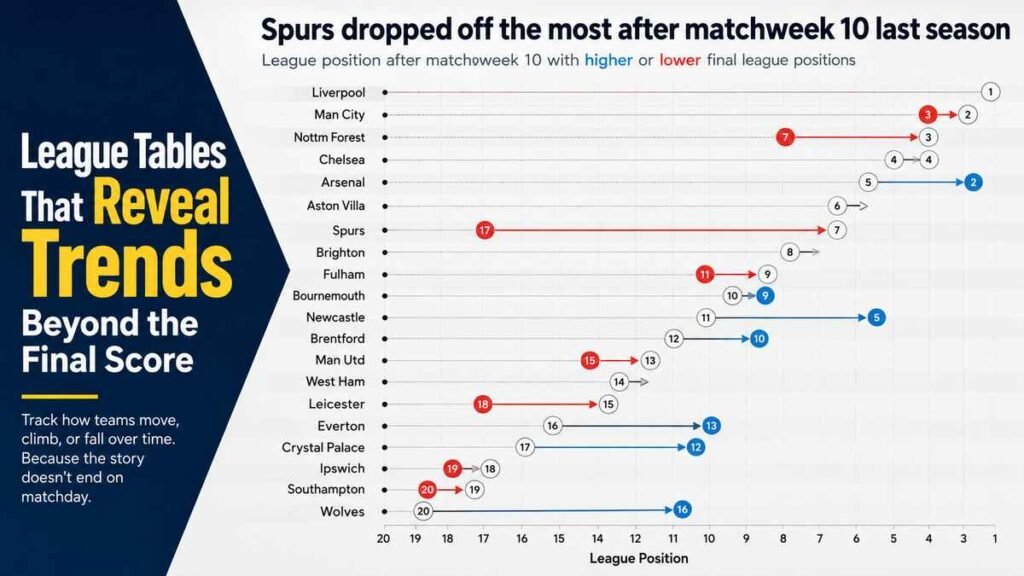

Hey, if you’ve ever stared at a league table after your team dropped points in a match they “deserved” to win, you know the frustration. Three points separate glory from gloom on paper, but the real story often sits hidden in the numbers underneath. As someone who’s spent countless weekends poring over match stats, arguing with friends, and trying to make sense of why results feel off, I’ve learned that league tables hold far more value when you look past the final positions.
They can highlight underlying trends in team performance, luck streaks, tactical shifts, and even future potential. This goes for fans wanting to understand their club’s direction, bettors seeking an edge, or anyone curious about the beautiful game. Let’s walk through how to read these tables in a way that actually helps, using real examples and straightforward explanations. No hype, just useful stuff from seasons I’ve followed closely.
The Limitations of Standard League Tables
League tables rank teams by points, with wins giving three, draws one, and losses none. Add in goals for and against for tiebreakers, and that’s the snapshot most people check first. It feels simple and fair. But it often misses context.
Take a recent Premier League season where Arsenal sat high up while Manchester United showed strong late form. On the surface, positions tell one tale. Dig a bit, and you see how home/away splits, fixture difficulty, and random bounces of the ball paint something different. A team might climb the table on the back of a few late goals or penalties while another creates better chances consistently but finishes poorly.
This gap matters because football is low-scoring. One deflection or brilliant save can swing results. Over 38 games, these small differences add up, but single matches hide them. That’s why many of us feel tables don’t fully capture a team’s quality mid-season. A side in 10th might play better football than one in 6th if you account for the quality of opportunities created.
I’ve had seasons where my supported team looked safe based on points but the underlying numbers suggested trouble ahead. It changes how you watch games – less panic after a loss, more focus on patterns.
Also Read: StreamEast.com: Watch Free Live Sports with Amazing Secrets.
Form Guides: Spotting Momentum Shifts
Most league tables now include a form column showing the last five or six matches. This is one of the first places to look beyond total points. A team with poor overall standing but winning their last four games carries different momentum than one with the same points but three straight losses.
Form reveals short-term trends. Injuries, new tactics, or confidence can turn results quickly. For instance, in recent campaigns, sides like Manchester United have gone on strong runs late in the season, climbing the form table even if their overall position lagged.
Pay attention to home versus away form too. Some teams transform at home with crowd support and familiar setups. Others grind out away draws against tough opponents. These splits often explain why two teams with similar points feel very different.
When I check form, I note opponents faced. Beating bottom teams is good, but stringing results against top sides shows real progress. This helps predict near-term performance better than overall standings alone.
Expected Goals (xG): Measuring What Should Have Happened
If one metric changed how I view football, it’s xG – expected goals. It assigns a probability to every shot based on location, angle, type, and other factors from thousands of past attempts. Sum them up, and you get how many goals a team “should” have scored.
Why does this matter for league tables? A team overperforming their xG (scoring more than expected) might regress. One underperforming could improve as finishing evens out. Tables showing goals for/against hide this. xG tables expose sustainable performance.
In practice, look at season-long xG differences. A mid-table team with positive xG (creating better chances than conceded) often improves. I’ve seen this play out where “lucky” leaders drop off while consistent chance-creators climb.
Models vary slightly by provider, but the idea stays consistent. Non-penalty xG removes some variability from spot kicks. Over a season, it correlates better with future results than raw goals in many cases.
For fans, this reduces frustration. Your team lost 1-0 but had 1.8 xG to the opponent’s 0.6? They played well; bad luck or a great keeper intervened. It builds patience during rough patches.
Also Read: Streameast Live: Best Way to Watch Sports Streams Online.
Other Metrics That Add Depth to Tables
Beyond xG, several stats help decode trends:
- Possession and Pass Accuracy: High possession doesn’t guarantee wins if it’s sideways passing in safe areas. Look for progressive passes or passes into the final third.
- Shots and Shots on Target: Volume and quality matter. A team taking many shots from distance might have low xG despite high numbers.
- Goal Difference and Expected Goal Difference (xGD): xGD combines attacking and defensive xG. Teams with strong xGD tend to sustain success.
- Set-Piece Performance: Some sides rely heavily on corners or free kicks. Tables rarely break this out, but it explains outlier results.
- PPDA (Passes Per Defensive Action): Measures pressing intensity. Lower numbers indicate aggressive, high-pressing styles that can fatigue teams late in seasons.
Combining these with league position gives a fuller picture. A bottom team with improving xGD and strong recent form might be turning a corner, even if points lag due to early losses.
Real Examples from Premier League Seasons
Let’s ground this in specifics. In one season I followed closely, Arsenal led the table with solid points, but underlying numbers showed Manchester City creating higher quality chances at times. Form guides highlighted Arsenal’s consistency.
Another case: teams fighting relegation. A side like Burnley or Wolves might sit low but show decent xG against top opponents, suggesting potential with better finishing or luck. Conversely, a team punching above weight on goals could face a drop without tactical fixes.
Mid-table sides often provide the best study material. They lack the cushion of big spending or the desperation of relegation battles, so trends show clearly. One season, Manchester United’s late surge appeared in form tables and xG recovery before points fully reflected it.
These patterns repeat across leagues. Whether Premier League, Bundesliga, or lower divisions, the principles hold. Data sites make this accessible now – no need for insider access.
Also Read: Streameast MLB: Master Streaming Tips for Reliable Games.
Using Advanced Tables for Betting and Fantasy
For those who bet or play fantasy football, league tables with extra layers become powerful. Raw standings mislead on value. A team undervalued by bookies (strong xG but poor results) offers opportunities.
I once followed a season where focusing on xG over results helped identify bets on “underdogs” who dominated chances. Form combined with fixture run gave edges on short-term props. It’s not foolproof – variance exists – but it beats guessing based on league position alone.
In fantasy, player xG and xA (expected assists) highlight those creating or finishing consistently, even without end product yet. This helps captain choices or transfer timing.
Always cross-reference multiple sources. Different models weight factors uniquely, but agreement across them strengthens confidence.
Insights for Coaches, Scouts, and Club Decisions
Professionals use these extended views for recruitment and tactics. A striker with high xG but low conversion might need service tweaks or confidence work. Defenses conceding low xG show organization worth building around.
Tables tracking these over time reveal improvement or decline. A young squad with positive underlying numbers but mid-table points suggests bright future. Veterans overperforming might indicate short-term success masking decline.
For fans, this knowledge deepens appreciation. You notice tactical adjustments mid-game or why a manager persists with a system despite results.
Also Read: StreamEast UFC: Best Unmissable Live Streams and Schedule.
Common Pitfalls When Reading Deeper Tables
Small sample sizes mislead. Early season xG can swing wildly. Ten games isn’t enough for firm conclusions. Look at rolling averages or full halves of seasons.
Context always counts: injuries, red cards, weather, referee decisions. No metric captures everything.
Over-reliance on one stat ignores the human element – motivation, leadership, adaptability. Numbers guide; they don’t replace watching matches.
Building Your Own Analysis Routine
Start simple. Check official league tables for basics, then form guides. Add xG from sites like FBref or Understat. Note patterns weekly.
Compare your team to similar ones in style or budget. Track changes after managerial shifts or key signings. Over time, you’ll spot trends faster.
For deeper dives, spreadsheets help track personal notes alongside public data. It’s rewarding when your read on a team’s trajectory proves right.
Also Read: StreamEast WWE: Best Streaming Options, Schedules, and Tips.
Why This Matters More Now
Modern football generates massive data. Fans access what pros used exclusively years ago. This levels understanding and fuels better conversations.
Whether you support a giant or underdog, looking beyond scores connects you more to the game. It turns casual viewing into informed engagement. Results still rule on the day, but trends in tables predict longer arcs.
Next time you glance at standings, spend a few minutes on the extras. You might see your team differently – maybe more hopeful, or with clearer areas to improve. Football rewards the curious. The numbers are there; the stories they tell make following seasons richer.
For more useful articles, visit my website:StreamEastt.us.